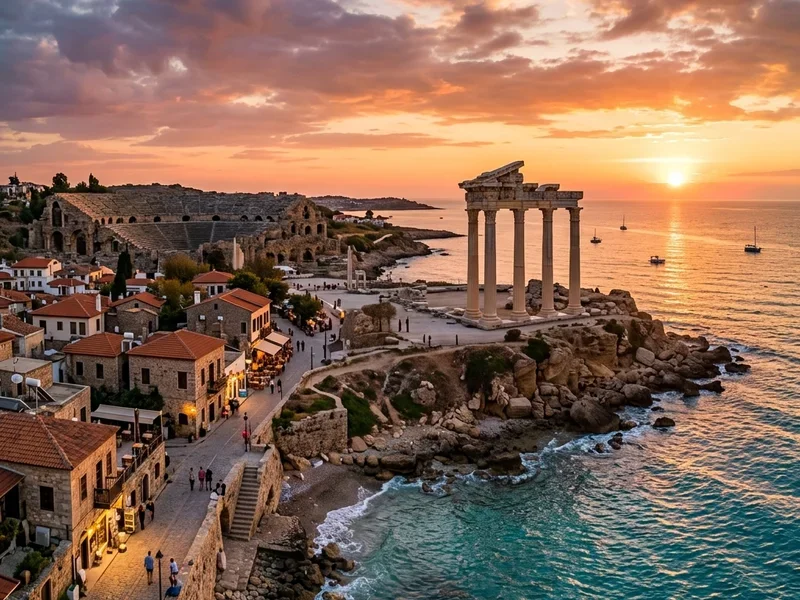
The Stage That Defined an Ancient City
Few monuments announce a city quite like the Roman theatre of Side. Rising at the very entrance to this ancient harbour town on Turkey's Mediterranean coast, it is impossible to ignore — a towering crescent of weathered limestone that has watched over Side for nearly nineteen centuries. Built in the 2nd century AD, it is the largest theatre in the region, and stepping into its hollow embrace is one of the most memorable experiences along the entire Pamphylian coast.
A Marvel of Roman Engineering
Most ancient Greek theatres were carved into convenient hillsides, leaning on the land for support. Side's builders had no such luxury on their flat coastal peninsula — so they did something audacious. They raised the entire auditorium on a series of massive arched vaults, creating an enormous freestanding structure entirely from masonry. Walking beneath these galleries today, you can still trace the genius of the architects who made it possible.
The result was a colossus seating somewhere between 15,000 and 20,000 spectators, fronted by a richly decorated multi-storey stage building once adorned with columns, niches and sculptural reliefs.
From Drama to Gladiators
The theatre's life mirrored the changing tastes of the Roman world. It began by hosting classical plays, but as appetites shifted it was adapted for gladiatorial combat and even staged wild-animal hunts, with a protective barrier added to shield the audience from the spectacle below.
What to See
- The vaulted galleries: Walk through the arched substructures that hold the entire theatre aloft — a rare chance to see Roman engineering from the inside.
- The stage building (skene): Examine the surviving fragments of carved reliefs and decorative stonework that once framed the performances.
- The upper tiers: Climb high for a sweeping panorama over the ancient town, the temples by the sea and the sparkling Mediterranean beyond.
- The monumental gateway: Pause at the nearby Vespasian gate and city walls as you enter the archaeological site.
- The acoustics: Stand at the centre and speak — the sound still carries up the steep banks of seating.
Pro tip: Come in the soft light of early morning or late afternoon. The midday sun on the open stone is fierce, the crowds thinner at the edges of the day, and the golden light makes the limestone glow for unforgettable photographs.
Getting There & Planning Your Visit
Side sits roughly 75 km east of Antalya Airport (AYT), within easy reach of the resort towns of Side, Manavgat, Belek and Alanya. The theatre stands right at the entrance to the ancient quarter, so it is usually the first — and grandest — stop on any visit to old Side. Wear sturdy shoes for the uneven steps, bring water and sun protection, and allow time afterwards to wander the surrounding ruins, the Temple of Apollo by the shore and Side's charming seaside lanes.
Ready to stand where ancient audiences once gasped and cheered? Browse the Seven Tours range of guided excursions and day trips across the Side and Manavgat region, and let us bring the story of this remarkable theatre vividly to life.