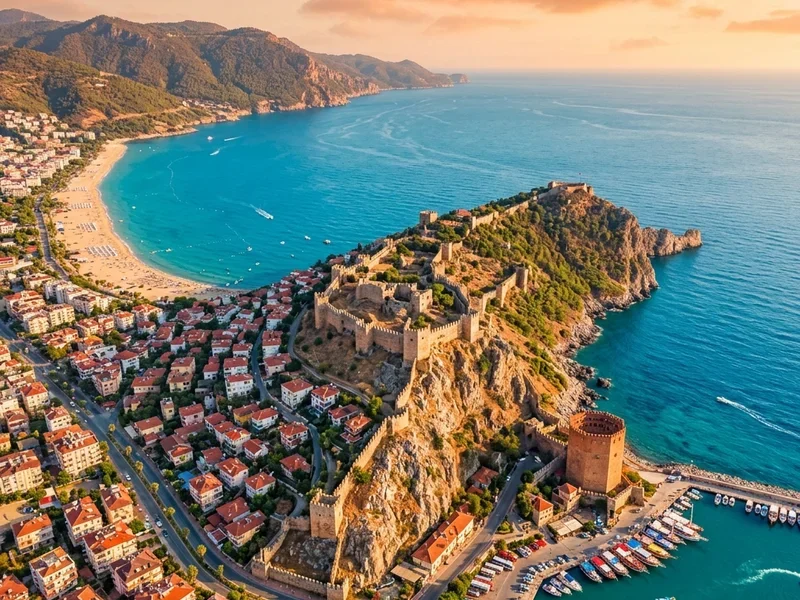
A compact museum with a long timeline
Two streets back from Cleopatra Beach, the Alanya Archaeological Museum holds far more history than its size suggests. Opened in 1967, it gathers what archaeologists have pulled from the soil and the sea around Alanya, then arranges it so a single walk takes you from the Bronze Age to the Ottomans. You can read the whole place in under an hour, which makes it an easy pairing with nearby Damlataş Cave.
What the galleries hold
The archaeological rooms move chronologically through the Classical, Hellenistic, Roman, Byzantine and Seljuk eras. Greek and Latin inscriptions sit alongside coins, oil lamps, blown glass and painted ceramics, and a few floor mosaics show the decorative taste of Roman households on this coast. The labelling is practical rather than dense, so the objects do most of the talking.
The Herakles bronze
The piece most visitors come for is a small Roman bronze of Herakles, cast hollow and standing only about half a metre tall. It rewards a slow look: the modelling of the muscles and the weight shifted onto one leg show why it became the museum's signature object. Recovered from the region rather than imported, it is the kind of find that explains why a small coastal town earned its own archaeological collection in the first place.
Beyond the antiquities
An ethnographic wing shifts the mood entirely, recreating a traditional Alanya home with carpets, woven textiles, copperware and the tools of local crafts. Outside, the garden is its own quiet exhibit, with sarcophagi, weathered statues and rows of amphorae set among the planting.
- Roman bronze Herakles: the hollow-cast statuette that anchors the collection.
- Inscriptions and coins: Greek and Latin texts and minted money that date the region's history.
- Glass and ceramics: everyday Roman and Byzantine objects, some near-complete.
- Floor mosaics: geometric and figural panels from local houses.
- Ethnographic rooms: a reconstructed Alanya interior with carpets and crafts.
- The garden: open-air sarcophagi, statues and amphorae.
Pro tip: Save the museum for the hottest part of the afternoon or a grey day. The indoor galleries stay cool, and you can step straight onto Cleopatra Beach afterwards once the light softens.
Getting There & Planning Your Visit
The museum sits in central Alanya, walkable from the harbour, the beach promenade and Damlataş Cave, so most visitors reach it on foot as part of a day already spent in the old town. Drivers reach the centre from the wider resort strip in a short hop along the coast road, though parking near the seafront fills quickly in high season. If you are flying in, Gazipaşa-Alanya Airport (GZP) is the closest at around 35 km, while Antalya Airport (AYT) lies roughly 120 km west. Allow about an hour inside, and check current opening days before you go, as smaller Turkish museums can close one day a week.
If you would rather fold the museum into a fuller day, Seven Tours runs Alanya excursions that combine the old town, the castle and a boat trip along the coast, with the museum as an easy add-on between stops. Ask our team to slot it into an itinerary that suits your pace.